
Castro County Court Records After Arrest
The court-record path in Castro County starts with a clear split. The Castro County Jail and the sheriff's office handle custody status, release status, bond questions, and local booking records. The court side begins when a prosecutor files or presents a charge and the clerk opens or maintains the case record. That distinction matters because an arrest charge is not always the charge that appears in court later. A person can be booked on one offense, have a charge amended, have a charge declined, or face a new charge after prosecutor review.
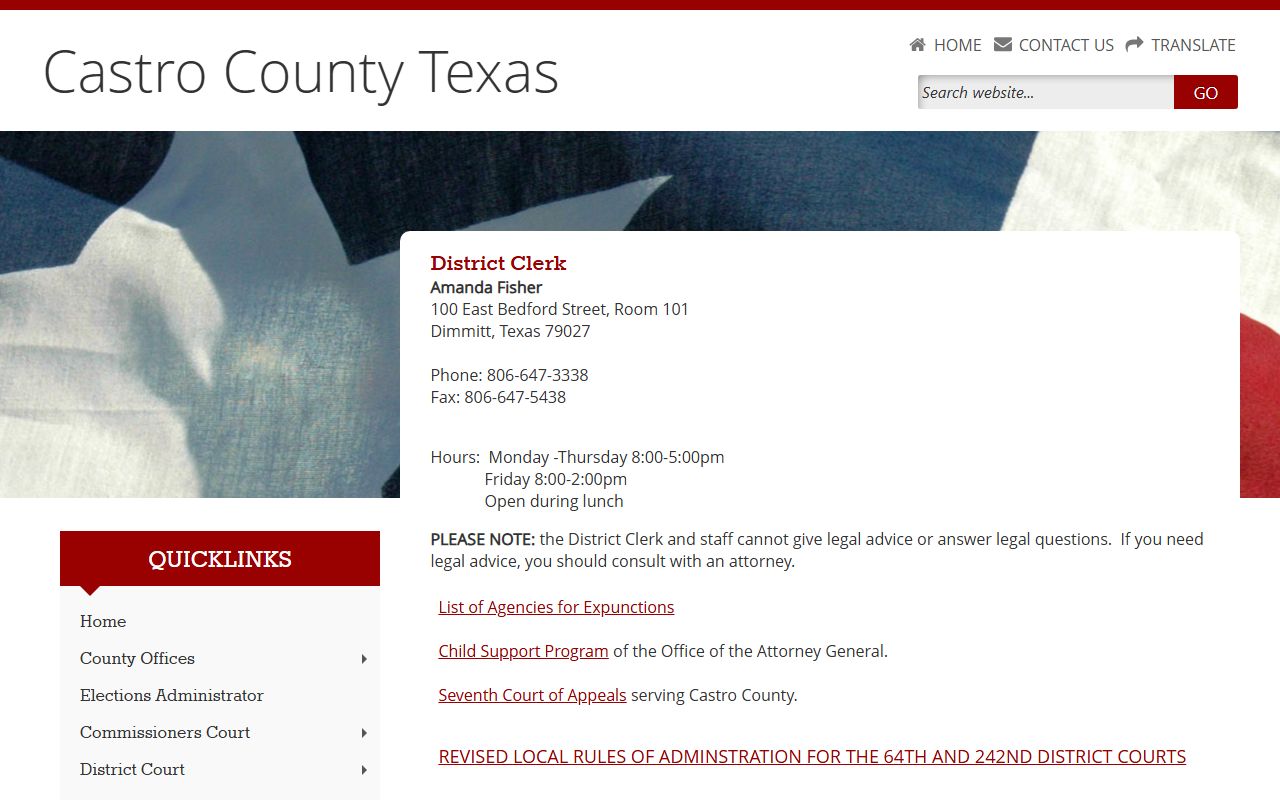
For the custody side, the Castro County Sheriff's Office lists Sheriff Salvador Rivera, the Castro County Jail address at 900 E. Bedford Street, Dimmitt, Texas 79027, and phone 806-647-3311. The sheriff page points users to VINELink for custody status. For court records after a jail arrest, the local clerk contact is the County Clerk and District Clerk at 100 E. Bedford Street, Room 101, Dimmitt, TX 79027, phone 806-647-3338. That clerk channel is where a user checks whether the arrest has become a filed criminal case.
Booking and custody details are handled separately from formal charges. For the roster and custody path, use Castro County jail inmate records. For booking photos and photo requests, use the separate Castro County jail mugshots page. Court records after an arrest should focus on the case number, charging paper, court date, charge level, bond order, warrant status, and disposition.
Castro County Criminal Records Offices
Castro County does not publish an official online criminal case-search portal in the sources reviewed. The County Clerk page and District Clerk page list Amanda Fisher at Room 101 in the courthouse, with the same phone number and office hours. Felony and district-court matters generally route through the District Clerk, while county-level and misdemeanor matters may route through the County Clerk. Because the county uses the same named clerk contact online, a caller should state the defendant name, arrest date, and any case number, then ask which clerk file holds the criminal matter.
The prosecutor link in the chain is the District Attorney or County Attorney. Both official pages identify Shalyn Hamlin at 100 E. Bedford Street, Room 213, Dimmitt, Texas 79027, phone 806-647-4445. The prosecutor reviews facts from law enforcement and files or declines charges. Victim-service routing, charging status, and prosecutor-office process should be directed there, but clerk staff and prosecutor staff cannot give legal advice to defendants.
District and County Clerk
100 E. Bedford Street, Room 101
Dimmitt, TX 79027
806-647-3338
Criminal case filing and court-record access
District Attorney and County Attorney
100 E. Bedford Street, Room 213
Dimmitt, TX 79027
806-647-4445
Charging review and prosecutor routing
No Castro County Criminal Portal
The official public-records portal linked from the clerk is not a criminal case portal. The Castro County Clerk public records website is a real-property records portal hosted for land and official public-record images. It supports real-property searching by name, document, book, and date, and the research notes that free searching and watermarked viewing are available while printed or downloaded real-property pages may carry per-page fees. That system should not be treated as a criminal charge index.
Because no official Castro County criminal portal was located, the most reliable court-record workflow is contact based. Start with the sheriff or Dimmitt Police if the arrest details are unclear. Then ask the clerk whether a criminal case has been filed. If the case is new, the clerk may need the full name, date of birth if known, arresting agency, approximate arrest date, or case number. Older files, sealed files, and expunction-related records may require in-person review, a written request, or a court order.
| Official Portal Field | Type | Criminal Use | Notes |
|---|---|---|---|
| Office | Dropdown | No | The available office is Real Property, not criminal court. |
| Search Type | Menu | No | Name, document, book, and date search support land records. |
| Business/Last Name | Text | No | A name match in the land portal is not a criminal charge result. |
| Document Types | Dropdown | No | The document list uses land-record codes and names. |
The official Castro County District Clerk page is the better starting source for court-record contacts. It also carries legal-advice limits and expunction-agency material, which helps explain why staff can route records questions but cannot tell a person how to defend or clear a case.
The official District Clerk page identifies the local court-record office for criminal filings and expunction-related routing.
Find Castro County Charges
A practical charge search starts with enough facts to avoid mixing up people with the same or similar names. If the person is still in custody, the jail can often confirm whether a magistrate appearance or bond decision has occurred. If the person has been released, the clerk is the better office for court dates, filed charges, and case numbers. City arrests may involve Dimmitt Police first, but jail custody still commonly routes through the county facility.
- Call Castro County Jail or the sheriff at 806-647-3311 to confirm custody, release, transfer, bond, and arresting agency.
- If the arrest was by city police, use the Dimmitt Police 24-hour non-emergency number, 806-647-4545, for local report routing.
- Ask the clerk at 806-647-3338 whether a criminal case has been filed and whether it is a district-court or county-level matter.
- Use any case number to request the charging document, court date, charge list, bond order, and current disposition.
- For prosecutor status or victim-service routing, contact Shalyn Hamlin's office at 806-647-4445.
Texas law also shapes the timeline. Code of Criminal Procedure Article 15.17 governs the magistrate-warning step after arrest. Chapter 17 covers bail and release conditions. Those laws do not create an online Castro County portal, but they explain why a person may have a jail record before the final filed charge appears in a court file.
Castro County Charging Documents
After a jail arrest, the court record is built from charging papers and orders. A complaint can support an arrest or early case step. An information is a prosecutor-filed charging instrument often associated with misdemeanor practice and some felony contexts allowed by law. An indictment comes from grand-jury action and is common in felony prosecution. The exact route depends on the offense, the court, and Texas procedure.
| Document | Who Uses It | What It Means | Records Note |
|---|---|---|---|
| Complaint | Law enforcement or prosecutor | States an accusation or supports early court action. | May appear before later prosecutor review changes the case. |
| Information | Prosecutor | Formally charges an offense without an indictment where allowed. | Ask the clerk for the filed instrument and any amendments. |
| Indictment | Grand jury | Accuses a person of an offense after grand-jury action. | Common felony route, but it can come after the jail booking. |
The main point is timing. The booking record is an intake record. The complaint, information, or indictment is a court record. When those records differ, the filed court charge is usually the more useful source for future court dates and case status.
Castro County Charge Status
Charge status terms show where a case stands. They do not all mean guilt. A pending charge is unresolved. An amended charge may have changed after prosecutor review, plea talks, or a court order. A dismissed charge ended without a conviction on that count. Deferred adjudication is a Texas disposition where final conviction consequences depend on successful completion and legal context. Because words like these affect rights, work, housing, and future court duties, the records check should be paired with legal advice when a person is a defendant.
| Status | Plain Meaning | What To Check |
|---|---|---|
| Pending | The charge is active and not finally resolved. | Next court date, bond terms, and attorney status. |
| Filed | The prosecutor has placed a charge in court. | Charging paper, case number, and court assignment. |
| Amended or reduced | The charge changed after filing. | Original charge, amended charge, and order date. |
| Dismissed | The charge ended without a conviction on that charge. | Whether expunction or sealing may be available. |
| Deferred adjudication | A Texas disposition tied to court-ordered conditions. | Terms, completion status, and public-record effect. |
| Convicted | A final finding or plea resulted in conviction. | Sentence, probation terms, jail credit, and appeals. |
Castro County Court Holds
Bond information may appear in jail or court records, but it can be incomplete if another hold exists. Castro County research notes cash bond, surety bond, personal bond, property bond, and no-bond hold concepts. A no-bond hold may involve a warrant, parole or blue-warrant status, federal process, immigration custody, or another court order. The sheriff's phone line is the local fallback when public online records do not show whether a person can be released.
No official Castro County active-warrant portal, most-wanted page, sheriff app warrant tool, or warrant PDF was located. That means warrant questions should be handled with care. The sheriff can address county warrants and custody status. The clerk can address filed cases and court settings. The prosecutor can route charging questions. A warrant is a legal-risk issue, so a person should verify identity carefully and seek counsel instead of relying on a name-only search result.
Castro County Charges Versus Convictions
An arrest, a charge, and a conviction are different records. The difference is especially important in Castro County because there is no single public criminal portal that merges jail status, prosecutor action, and court outcome. A charge is an accusation in a case. A conviction is a final result after a plea or finding. A dismissed charge may still leave records until a court grants an expunction or other legal remedy.
| Point | Charge | Conviction |
|---|---|---|
| Stage | Accusation filed or pending in court. | Final result after plea, verdict, or adjudication. |
| Proof level | Based on accusation and legal filing standards. | Based on a plea or court finding under criminal procedure. |
| Records effect | Can appear in court records even if later dismissed. | Can affect sentence, supervision, and criminal history. |
| What to request | Charging document and current status. | Judgment, sentence, probation order, or disposition sheet. |
Castro County Sealed Records
Texas public access starts with the Public Information Act, but not every law-enforcement or court record is open in the same way. Texas Government Code Chapter 552 is the open-records law, and Section 552.108 can protect law-enforcement and prosecution information in defined circumstances. For qualifying arrests, Code of Criminal Procedure Chapter 55 supplies the expunction route. Clerk staff can point to records, but legal eligibility questions belong with counsel.
| Record Treatment | Sealed | Expunged |
|---|---|---|
| Public view | Restricted from ordinary public access. | Removed or destroyed as ordered by the court. |
| Legal basis | Depends on the type of case and order entered. | Chapter 55 controls qualifying Texas expunctions. |
| Agency effect | Some agencies may retain limited access. | Agencies follow the expunction order's terms. |
| Next step | Ask the clerk what order exists. | Ask whether an expunction order was signed and sent. |
Important: Private background checks and consumer reports have separate legal rules. Verify Castro County case facts with the originating court office.